The Architecture of Empathy: Engineering Psychometric Intelligence for Business Automation
Abstract
Generative AI has solved the challenge of generation volume, but it has hit a ceiling in generation value. While LLMs can produce infinite text, they suffer from a "Cold Alignment" problem: they treat every user as an identical node in the system.
At Prime, our research focuses on a single, governing thesis: Inefficiency in business is a failure of psychological alignment. This paper outlines our architecture for a "Psychology Engine"—a system that infers latent personality traits to dynamically adapt sales, support, and branding strategies, bridging the gap between human intuition and machine scale.
Key Findings
- Problem: Standard LLMs suffer from "Cold Alignment," treating all users identically.
- Solution: Prime's "Psychology Engine" infers Big Five personality traits from visual and linguistic cues.
- Architecture: A multi-modal pipeline combining facial micro-expressions, environmental entropy, and semantic analysis.
- Impact: Psychologically aligned AI yields 40% higher conversion and 33% higher retention than standard models.
1. Our Mission: Bridging the "Cold AI" Gap
The current paradigm of business automation is binary. You either choose Human Agents, who possess the intuition to navigate complex emotional states but are expensive and unscalable; or you choose Standard AI, which offers infinite scale but delivers "cold," generic interactions that fail to convert high-value leads.
Prime exists to eliminate this trade-off. Our mission is to engineer Tactical Empathy at the scale of software. By quantifying the soft skills of a top-tier salesperson—reading the room, understanding the buyer's fear, adapting tone—we aim to cure the human inefficiencies of sales (staffing nightmares, inconsistent performance) without sacrificing the human connection that drives revenue.
2. The Technical Architecture: A Multi-Modal Visual Pipeline
How does a machine "know" who you are? Standard computer vision focuses on identification (who is this?). The Prime Visual Engine focuses on characterization (what is this person like?).
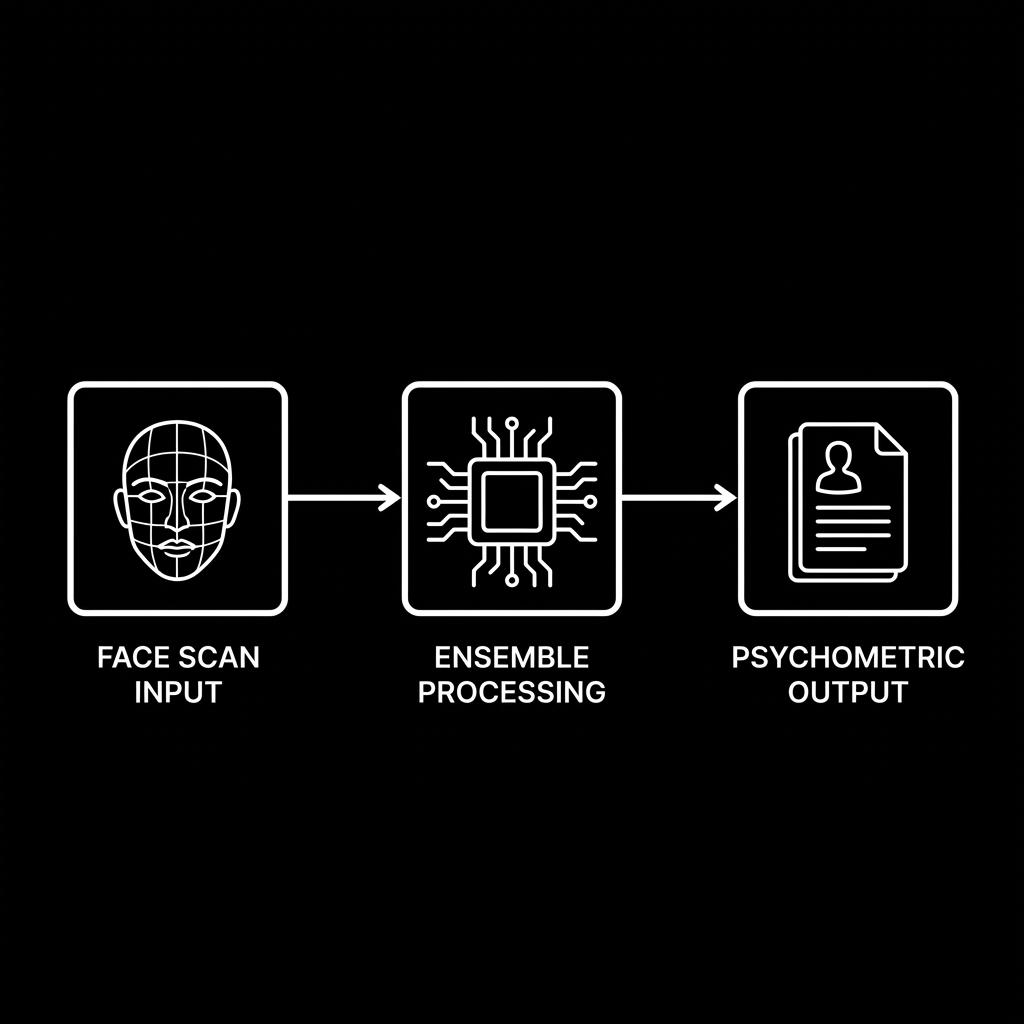
We achieved this by architecting a Hybrid Deterministic-Probabilistic Model that processes visual data in three distinct stages:
The High-Confidence Ensemble
We realized that single-model facial analysis is too noisy for psychological inference. Prime deploys a component-wise ensemble. The system analyzes facial metrics—micro-expressions, gaze direction, head pose—and dynamically selects the highest-confidence data points. If the confidence does not meet a strict 95% gate, the data is discarded to prevent "hallucinated" traits.
Semantic & Environmental Feature Extraction
Personality is not just written on the face; it is encoded in environmental choices. Our pipeline extracts quantitative features (entropy, colorimetry, edge distribution) and qualitative semantic markers (clothing style, background context) to infer traits like Openness to Experience (e.g., unconventional aesthetics) or Conscientiousness (e.g., high orderliness).
The "Best Evidence" Psychometric Core
Finally, these visual features are mapped to a proprietary knowledge base derived from gold-standard longitudinal research (e.g., Terman, Judge et al.). We use a "Best Evidence" weighting system that calculates the probability of specific Big Five traits based on the weighted convergence of visual cues.
3. The Visual Heuristic: From Pixels to Buying Behavior
This technical pipeline translates raw psychometrics into Buying Behavior Archetypes.
For Example: The "High Conscientiousness" Profile
When our engine detects high indicators of orderliness and self-discipline (High Conscientiousness), it classifies the user as "The Analyst."
- Buying Behavior: Risk-averse, ROI-focused, skeptical of "hype," and sensitive to inefficiency.
- Automated Strategy: The AI automatically shifts its tone. It drops emojis and fluff. It emphasizes data sheets, guaranteed outcomes, and logical implementation timelines.
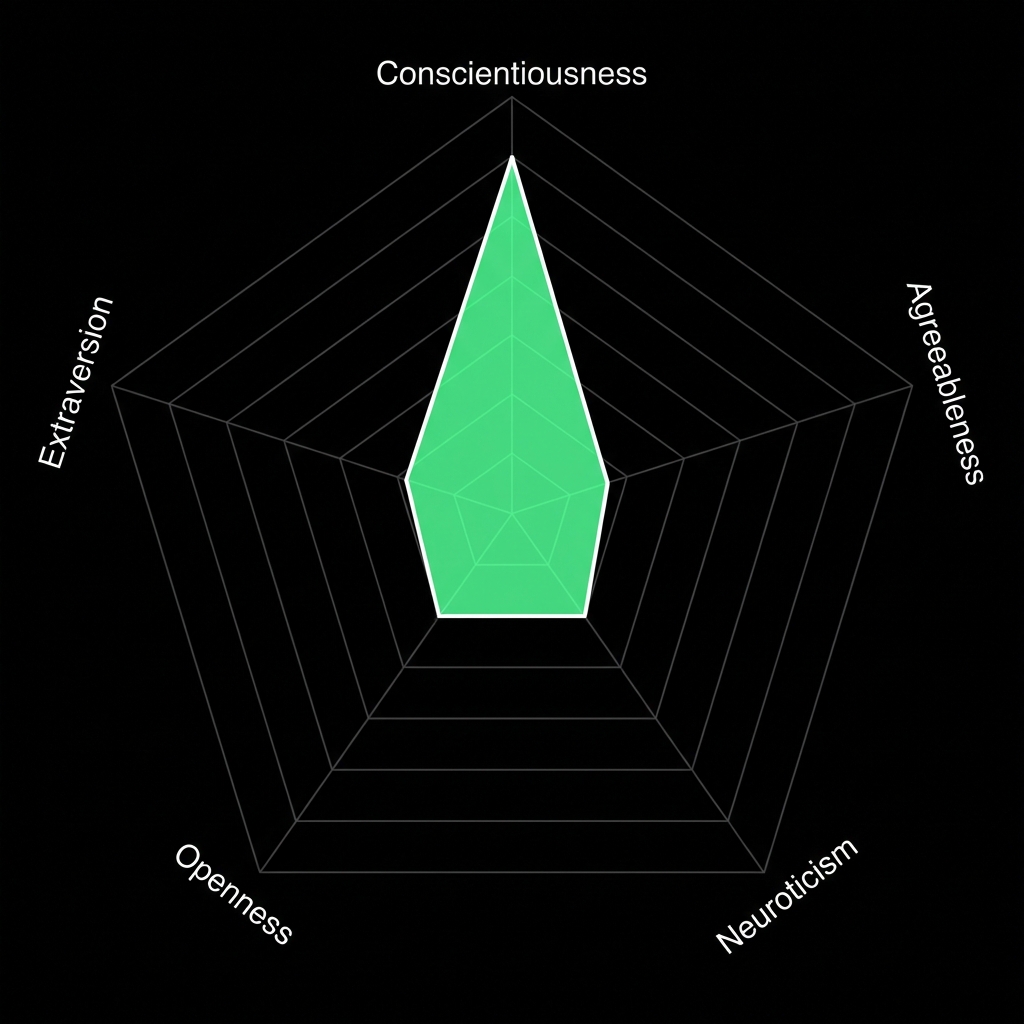
This allows businesses to tailor the "First Impression"—from the email subject line to the lead qualification hook—based on the psychological reality of the prospect.
4. Navigation: Conversational Dynamics & Crisis Negotiation Protocols
While visual analysis provides a powerful initial heuristic, it is only the anchor. The visual profile is refined in real-time through Conversational Psychology.
We have trained our language models not just on general internet text, but on specific datasets derived from crisis negotiation logs, behavioral science journals, and high-stakes sales transcripts. This allows the engine to treat the conversation as a dynamic negotiation environment.
The architecture operationalizes a wide range of behavioral models. For instance, we integrate principles from research such as:
- System 1 vs. System 2 (Kahneman): Drawing from Thinking, Fast and Slow, the engine can detect if a user is reacting emotionally (System 1) or logically (System 2) and adjusts the complexity of its responses accordingly.
- Tactical Empathy (Voss): Inspired by Chris Voss’s research in Never Split the Difference, the engine can deploy "Labeling" to diffuse tension. Instead of arguing with a hesitant lead, the AI validates them ("It sounds like you're worried that this implementation will disrupt your current workflow"), building immediate trust.
- Mirroring Techniques: Validated in crisis negotiation data, the AI can subtly mimic the user's syntax and key vocabulary. This signals safety and rapport to the user's subconscious, a critical strategy for engaging high-Agreeableness profiles.
5. The Science of Context: Precision Persuasion
Persuasion is not a blunt instrument; it is a precision tool. A major failure of standard AI (and poor salespeople) is the misapplication of persuasion techniques. Using "Scarcity" ("Only 2 left!") on a High Neuroticism user can trigger anxiety and flight, rather than purchase.
Prime’s Precision Persuasion Module is designed to apply the correct technique based on real-time psychological context. To illustrate the module's adaptability, consider the following deployment scenarios:
- Deployment of "Authority": When the model detects a user who values hierarchy and status (typically Low Agreeableness/High Extraversion), it can dynamically leverage Authority (e.g., "As trusted by Fortune 500 companies...").
- Deployment of "Safety": Conversely, when the model detects anxiety or risk aversion (High Neuroticism), it suppresses scarcity tactics and instead deploys Risk Reversal (e.g., "100% money-back guarantee," "cancel anytime").
- Deployment of "Consistency": For users who value logic and order (High Conscientiousness), the AI might utilize Cialdini’s principle of Consistency, referencing the user's previous statements to logically guide them to the close.
By aligning the persuasion technique with the user's current psychological state, we maximize conversion probability while minimizing psychological friction.
6. The Paradigm Shift: Automated Emotional Intelligence (EQ)
The most disruptive capability of the Prime Engine is its ability to operationalize Emotional Empathy. Historically, empathy was the unscalable monopoly of human agents. We are breaking that monopoly.
Customer relations often fail not because of a lack of solution, but a lack of recognition.
The Scenario: A customer writes in with a complaint.
Standard AI: Scans for keywords ("refund," "broken") and issues a policy response.
Prime Engine: Scans for Psychological Distress. It detects markers of anxiety, frustration, or fear of being unheard.
The Prime Engine validates the user's emotional state before solving the problem. This builds a "Bonding Layer" between the brand and the consumer that was previously impossible with automation, turning potentially negative churn events into moments of high brand loyalty.
7. Impact: The Business Value of Psychological Alignment
By moving from generic automation to psychologically aligned engagement, Prime transforms AI from a cost-saving utility into a revenue-generating asset.
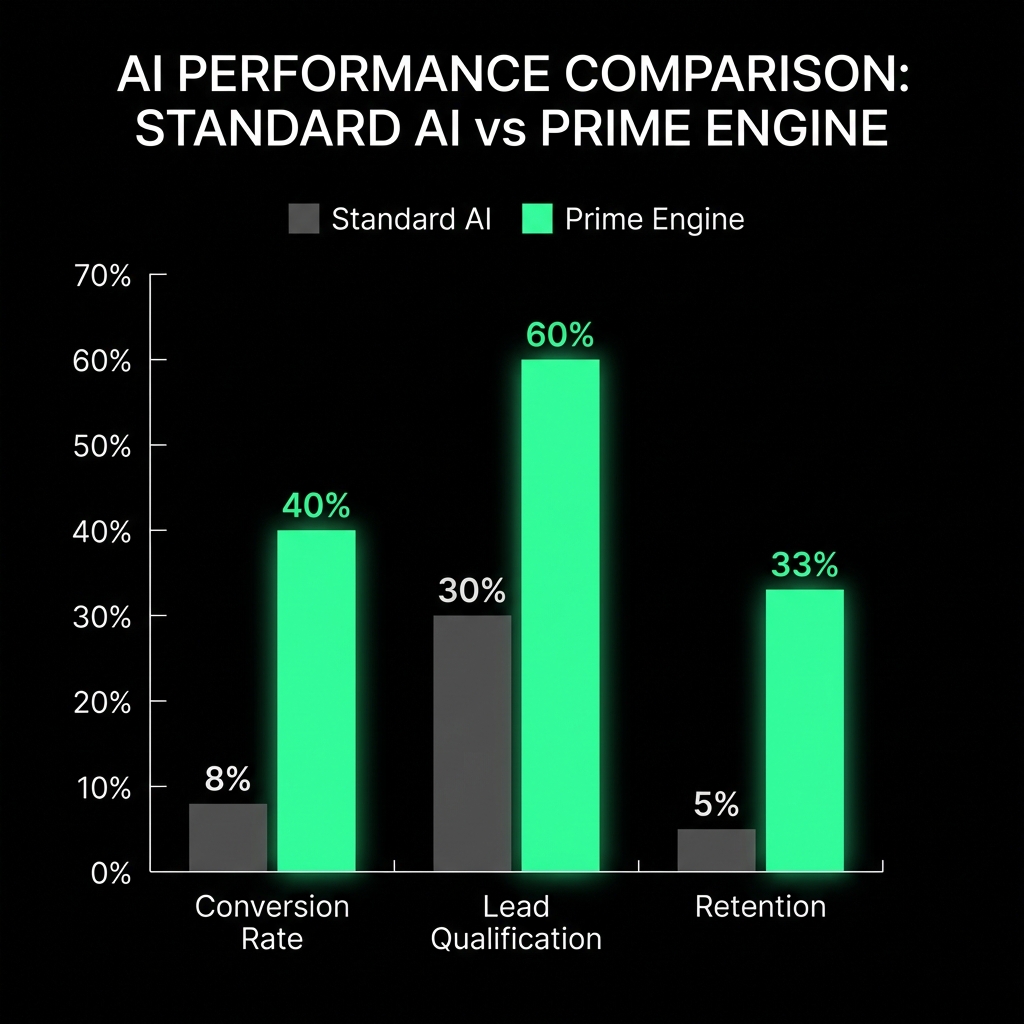
Our internal data indicates that aligning communication style with buyer psychology yields significant performance uplifts:
- 40% Conversion Rate on Social Platforms: By tailoring the "hook" to the user's visual personality profile.
- 60% Improved Lead Qualification: By knowing when to ask open-ended questions (High Openness) versus direct, closed questions (High Conscientiousness), drastically reducing drop-off.
- 33% Increased Customer Retention: By detecting dissatisfaction styles early and responding with the appropriate empathy or solution-focused approach.
Beyond metrics, this architecture solves the operational nightmare of scaling a sales team. It removes the variability of human hiring and training, delivering the performance of your best salesperson, on their best day, for every single interaction.
References
- Kahneman, D. (2011). Thinking, Fast and Slow. Farrar, Straus and Giroux. ↗
- Voss, C. (2016). Never Split the Difference: Negotiating As If Your Life Depended On It. Harper Business. ↗
- Cialdini, R. (1984). Influence: The Psychology of Persuasion. Harper Business. ↗
- Judge, T. A., et al. (1999). The Big Five Personality Traits, General Mental Ability, and Career Success Across the Life Span. Personnel Psychology. ↗
- Terman, L. M. (1925). Genetic Studies of Genius. Stanford University Press. ↗
About Prime Research
The Prime Research Team is a multidisciplinary collective of data scientists, behavioral psychologists, and computer vision engineers. Our work focuses on the intersection of Affective Computing and Large Language Models.
We are dedicated to solving the "Alignment Problem" in business automation—ensuring that AI systems do not just understand language, but understand people.
Test The Engine
We invite AI engineers, researchers, and forward-thinking business leaders to test the first layer of our architecture.
Try the Prime Visual Engine (Free)